Episode Transcript
[00:00:00] Speaker A: Foreign.
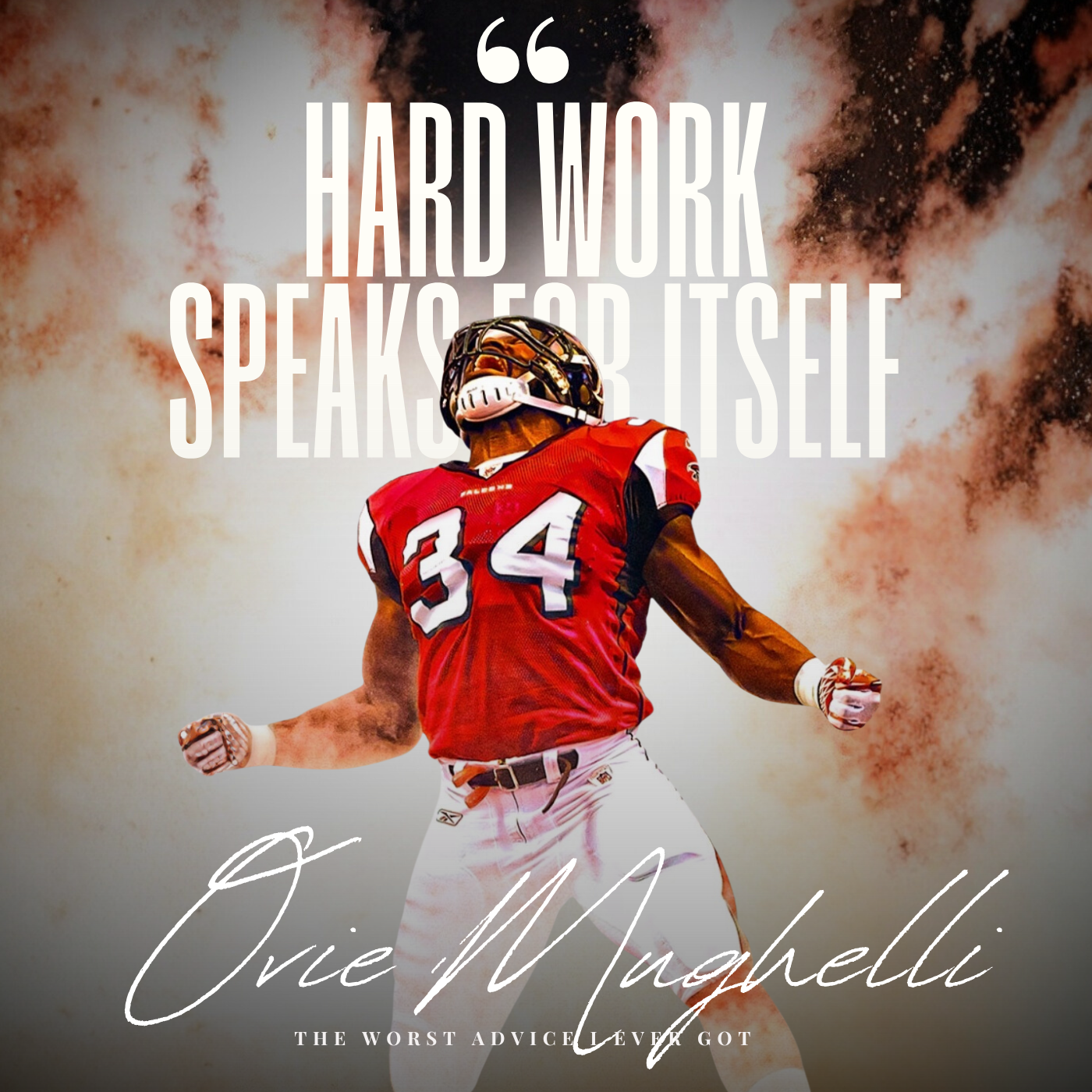
[00:00:05] Speaker B: Welcome to another episode of the Worst Advice I Ever Got. I'm your host Sean Taylor, along with my producer jb and today our special guest is Ovi Mahali. OVI is a name you might recognize from Sundays. He spent nine years in the NFL, became the highest paid fullback in league history and earned a Pro bowl spot by sheer persistence. He's also a leader in healthcare advocacy, a speaker, a business owner, helping people fight for their well being with the same drive that fueled his own NFL career. He's here today to talk about the worst advice he ever got with us. Hey Obi, thank you so much for joining us today.
[00:00:42] Speaker A: Thanks for having me, Obi.
[00:00:43] Speaker B: I'm really excited to hear your story. Tell, tell us what's the worst advice you ever got?
[00:00:49] Speaker A: The worst advice I ever got was that. And it sounds a little crazy, but hard work speaks for itself.
[00:00:54] Speaker B: Who, who gave you this advice? Was it a coach? Was it your parents? Where did it source from?
[00:01:00] Speaker A: I mean, I think it started from my, my first teachers, my first coaches, which were my parents. It made perfect sense to them because they again, they came from Nigeria to chase the American dream and they were not going to be outworked. They just refused to be outworked because they knew that this opportunity was something that they didn't want to mess up. And I was just like, if they were able to achieve all they achieved through hard work, it's got to be correct. Hard work, it speaks for itself. People will recognize you. Unfortunately, that doesn't always apply to every individual and didn't apply to me. I found out that it didn't apply to a lot of people.
[00:01:37] Speaker B: How did you come to the realization that it wasn't true? Like it, it's, I'm imagining you saw the recipe, you're following what your parents did. When did you first decide to maybe resist that advice or push back against.
[00:01:51] Speaker A: That advice, man, because they, they weren't wrong. In high school I worked hard. I was, it was kind of easier there because I was the only African American in my grade. And so needless to say, I stood out. It was a chance for me to, to discover myself and football was a part of that. And I worked hard because I wanted to be good and I was good. And the hard work somewhat paid off, but it wasn't enough by itself. My weight force career was a big transition for me because I was used to being the man in high school. I was until like I was the guy with four touchdowns. I was a guy who was, his name was on the front Page of the newspaper, college. Like most people, you go from being the best in high school, starting from the bottom, trying to prove yourself. I worked hard, worked hard, worked hard at tailback and I was like, you know, hard work is going to get me there. My parents built me on hard work and I wasn't able to find success until I was able to understand how to work hard and in what capacity. I work hard and you know where I'm going to work hard. And I had to literally adapt and adjust and change up my whole Persona. And I went from a two point stance to putting my hand in the dirt to three point stance. And I used to, it's funny, I used to make, not make fun of, but I, I told my lineman, hey, you're blocking for me. Like, hey, hey, you, you guys make sure that you clear the way. You guys make sure you make me look good. And it was, you know, like, as a lot of tailbacks too, I had a little bit of an ego because I was, I was the man. I was the front page was the, the guy with the ball in his hand. I was the guy who the camera followed. And going from a two point stance to three point stance, it put me in the trenches per se. And, and I had to learn that the hard work that I was doing as a tailback wasn't going to get me there no matter how hard I worked, because it's just not going to fit. So I had to find a fit for myself and I found that by switching from tailback to fullback.
[00:03:53] Speaker C: So when you were in high school and you're, you know, obviously you said you're the man, you're getting all the four touchdowns a game. You're g things. Were you getting a lot of like, were you having to advocate for yourself then to get college looks or were you getting college offers all over the place?
[00:04:06] Speaker A: You know that that's a, a great question.
Because part of the reason that I even got to Wake Forest University was because I had to wave people down because no one was looking at me. No one was giving me an opportunity. Sorry. I wasn't knowing Division 2 and Division 3 schools. I wanted to play D1. I was like, I had academic scholarship opportunities and athletic scholarship opportunities and I just did not want to go to like, you know, Podunk University because they gave me a scholarship. But academically I didn't want to go there or they didn't have the majors I wanted or they wasn't in the area. I didn't want to sacrifice just so I can play Football. I was not a football crazed individual. I wasn't a. All I can do is carry the rock or, you know, around a big skin type guy. I was like, I got a set of skills, I got talents. And for me, I'm just trying to find ways to put myself in a position to where I can really win. It was my coach who, after me pressing him, after me talking to him, he went to bat for me. Wake Forest was the only, I beat the only Division 1 school that really gave me an offer.
[00:05:14] Speaker C: And that's the first time you realize, like, that, that advice, right, like, the hard work is not going to speak for itself. Because, like, no, if I didn't, if my coach didn't go and like, say something, yeah, maybe you are at some Podung school doing something like, you know, it's like you really got to. Hard work does not speak for itself.
[00:05:28] Speaker B: But I would say you get Wake Forest to give you that commitment. My guess is your brain said, I will work harder than anyone there to prove, to prove to them. So you kind of revert back probably to that hard work recipe, don't you?
[00:05:41] Speaker A: Oh, absolutely. Absolutely. And you know the reason that it's the worst advice? Because it's never just hard work. And there are people who don't see that nuance of it. And they just work hard and, and they're frustrated, they're annoyed, they're, they're, you know, just, you know, a little bit depressed because, like, what else can I do? And I, I've been that guy. That's, that's how I'm on this podcast, talking to you about this issue because I've been that guy before. And it, it, it took just some, some, some insights from myself, from friends, from me, praying to realize that I got to do more. It, it's not just good enough to show people that, hey, I'm the biggest, I'm the strongest, I'm the fastest, or I work the hardest. You know, you've got to find ways to really, really let people know that, hey, look at me, I have something that can help you. I have something that, you know, can add value and you can work as hard as you want to. But if the people that are evaluating you, A, don't see you and B, they don't recognize the talent you bring to the table, that hard works for nothing. It's either at. In a closet, in a dark closet, in a dark room. And for a while I felt like that's what I was doing. All my hard work didn't really matter Unless somebody else saw that too.
[00:06:58] Speaker B: Hey, ov, how did this then repeat itself? When you were looking to enter the professional ranks after your Wake Forest career.
[00:07:06] Speaker A: It became even more frustrating because I, I felt like, all right, I understood that, hey, you know, it's not just hard work, but it's everything else around that. I, I feel like I did the hard work and I did, I did some more than that because I was a fullback that started every game of Wake Forest University. Like, as a freshman, I was playing with the seniors and I helped be a part of our first bowl game in, like, years. You can see that I am dominating guys at Florida State, at Clemson. And so I'm like, oh, this is great. This is easy. I'm gonna go to the NFL and it's gonna be, you know, easy pickings. I. I'm going to Baltimore block for Jamal Lewis. It's great. I was a third string fullback. I'm like, this is like college all over again. I work my butt off to show the coach during training camp that, hey, I'm better. Even though I'm new to the NFL, learning this playbook, I was like, I have more talent. Catches the ball, running the ball, and especially blocking did not matter. You know, and this was the situation where they saw me. It wasn't like high school where no one knew who I was, no one could see me. I had, you know, all types of proof that I could do the job. Then it became, hey, it's not about exposure, it's about the politics. Jamal tells the head coach, hey, I want this rookie blocking for me. I want Al Rar. We've been blocking together for two, three years, and that's my guy. And so no matter what I did, no matter how many pancakes I had, no matter how many one handed catches I had, no matter how many times, you know, even the defensive coach, like, yo, who's, who's that? Rookie fullback, he's all right, all that stuff. I'm like, I put on a show. I'm gonna get a chance to at least compete for the starting job.
Not once. And so college, I mean, NFL was difficult in that, in that aspect, because I go back to my room, sit there and just put my head down, say, what else can I do?
[00:08:51] Speaker C: So when you start to advocate for yourself, like to pull in, to be like, hey, man, like, look, I'm. The work is. I'm putting in the work. I've got the talent. So what do you. What's that next step into? Like, going, okay, hard work's not enough. Now I'm gonna do this.
[00:09:02] Speaker A: Yeah, it's. It's. It. It was. It. And it took a lot for me to.
To advocate for myself because I had lots of coaches. I would go to the receivers coach, who was a very outspoken guy, and, hey, man. Hey, man, keep doing your thing.
[00:09:17] Speaker C: Stay hung.
[00:09:18] Speaker A: I see you out there, like, yeah, just stay humble and, you know, stay hungry and. And you'll get there. I said, okay, okay, I'll do that. I'm still not getting the looks, I'm not getting the opportunities. And I'm like, why is it not working? Everyone says, you work hard, you keep your nose clean, you do your best, you'll find success. And I was doing all of that and. And still could not find success.
I had to get creative. And it took. It was. It was one coach, I think it was the special teams coach, who was like, ovi, they're not putting you in. I don't care how good you do. I don't care how much you outperform. There's somebody else in their ear. So if you want to change things up, you're gonna have to change things up.
And I was like, you're right. So I started.
I started a little mini campaign for myself where it just involved me going, going and talking to the coaches one on one. And I was like, what do you need to see for me, because I wanted to make it to where they could not. Not start me. I want to win.
Give me a playbook, essentially, to help me win. It wore him down eventually. It wore him down to the point where when the starting fullback actually got a little bit injured, they put me in.
When I finally did what I've been doing in multiple situations, but I had a full, like, weeks of practice to be the starting fullback. They didn't like me at defense because usually the first team defense and the. The first team office, they have an understanding where, hey, we're not going too hard. We have a game on Sunday. This is my Super Bowl.
[00:10:43] Speaker C: This is it.
[00:10:44] Speaker A: This is so every. I might not get the chance again. Most of the guys get healthy, they're going to come back. So my job is to dominate defenders, linebackers, defensive ends. That hard work didn't only make, make a statement, but the fact that I've been hitting these coordinators, the head coach, even the running back coach, and telling them, look at me, look at me, look at me. Look what I can do. Look, I can do. Give me a chance. Give me a chance that when I did it, when I did what I said, I was Going to do it made an even more of an impact because they were already had their antennas up and they were saying, he's, he's been saying this, he's been telling us, and now he just showed us.
[00:11:20] Speaker B: We associate you, I look behind you. You've got the Falcons helmet and you're talking about all this with your Ravens teammates, your Ravens coaching staff.
[00:11:29] Speaker A: Yeah.
[00:11:30] Speaker B: You got this opportunity. You started to show. Well, talk about that transition from that group that you work so hard to advocate for yourself for to going to a whole new team. Talk about that a little bit, man.
[00:11:44] Speaker A: Love my Ravens family, my Falcons family. Put me on top of the hill, like, and going to Atlanta and getting this monster contract, getting a chance to block for work done. Because he was a smaller tailback, they wanted a big fullback. And I, I was, it was a perfect storm. I was the biggest. I was 255, like 6% body fat, you know, and I was able to catch like a tailback and still run the ball like a tailback, but hit like a, like an offensive guard. And it was the worst season I've ever had as a team because we only won three, four games for six, seven, eight game losing streaks. Oh, I, I had, I haven't done with, dealt with that. That season was very rough because people need somebody to blame and you know, they're like, why didn't we do better in free agency?
[00:12:30] Speaker C: Like, we're paying this guy a lot.
[00:12:32] Speaker A: What's he doing? Yeah, why don't we get a, a db? Why don't we get a big time offensive tackle? We got a fullback. And so people were sending me messages like little hate mail. You made, you know, $80,000 per play this game. You're a waste of space here. They made a mistake and I, I, I, I felt it because again, I worked hard. I, I got a huge reward and I, I wanted to show the Falcons fans, the Falcons, my teammates, our owner, Arthur Blank. I wanted to show Rich McKay, who was a GM at the time, that, hey, you made a great decision and you did a great job by bringing me here and I'm going to give you that, you know, that, that value back. I couldn't do it. I couldn't do it. I was so, it's weird because I was happy because I was now a, a, a millionaire and you know, I bought this house I'm in right now and you know, dream come true. But I was so unfulfilled because I felt useless. I don't have a chance to even show people what I can do. So you talk about hard work. Hard work once again wasn't enough in this situation because I went to the gym, I went to the workouts, I went to the film room. I did everything I could do to make sure I was ready to give the Falcons, you know, fan base what they and the Falcons, you know, ownership, what they paid for. But I couldn't do that because there were things outside of my control.
[00:13:54] Speaker B: After, after football, did you stick to the same mentality of I got to work hard or did you see different avenues for again having to advocate for yourself and what you do today?
[00:14:06] Speaker A: No, it's, it's always advocate for yourself. I think that's one of the key things I tell kids now. I speak to individual about it. It's. I'm, I'm a humble person and I, I am very proud of what I've accomplished. But I never look at it. My parents raised us to where I never feel like I'm better than you because you didn't play NFL, you weren't a two time all pro fullback, you didn't go to the Wake Forest Sports hall of Fame, you don't have your jersey retired as your high school. Like you're not a multi. I think it's insane to look down on people about that. And so I feel like I'm humble in that. Right. But I also had to learn to take my humble hat off sometimes and in certain situations, let people know what you've accomplished, what you've done, and make sure that you, you demand them treat you with the respect that you've earned. I don't want you to give me anything that I wouldn't give back. I, I want you to give me what I've earned, what I fought for. And so that's something that I had to do several times in my career and still do now. I mean, the, One of the biggest things I almost forgot to mention is that my first Pro Bowl, I got all Pro in 2006 while I was with the Ravens. But Pro bowl and all Pro, they're, they're the same, but they're different and different characteristics and voting things. But Pro bowl is a big one. You, I walked to room. Now as a retired player, they can't say fullback over Mahal. They have to say Pro bowl fullback Obi Mahaly. Little old me, little old Charleston Sakala, Nigerian southern boy, had a chance to play with Giants, actually has to play with hall of Famers and I'm just me. But the Pro bowl was hard because once again I was the Best fullback in the league. My tailback to the Pro bowl His first two years, 2008, we were the number two rushing attack in the league. I didn't go to the Pro bowl until my third year with Mike, where I said, all right, I'm done with this. If I got to do a marketing campaign, let people know now, I'll do it. I had to market to the my teammates, not my teammates, to other linebackers. The linebackers vote on the best fullback. Add a market to the fans. And because the fans didn't know who's blocked for Michael Turner, because the camera's following Michael Turner, it's following the football. I'm on the bottom of a pile after I blocked some 350 pound linemen. They're not seeing me. Add a market to the fans, add a market to the media, the press. And when I say market, I have to go and I highlight my stuff, pay somebody to trade a whole reels, and all that stuff got me to the Pro Bowl. And it wouldn't have happened if I didn't say, you know what, my hard work's not enough. I got to make sure they see that hard work and I have to frame it correctly. And so, same thing. Now, as a former player, as a doctor son, I work in the healthcare space and it's important for me to help people do what I was trying to do and frankly, I had done for me, to advocate for people.
I'm passionate about the power of good health.
Living in this neighborhood. I got multi millionaires around me who would give all their money up for good health. And so working in the benefits spaces, which is what I do. My wife and I have a consulting firm. We do group health insurance, supplemental benefits, we do wellness programs. And we just give people ways to advocate for themselves, advocate for their loved ones, to advocate for how they want to live this thing we call life because we got one of them. It's precious. And I feel like the more opportunities and the more avenues you have to make sure that you live this life to the fullest, that you take care of yourself and your loved ones, the better you're going to be. If I could be a part of that by educating, by inspiring, by just making you aware of ways you can do that, then my job has been done.
[00:17:42] Speaker C: Hey, did you have to advocate for yourself post sports in a way of just like, I'm not just a dumb jock who's doing these, like, do people act, do that actually hurt you in a way that like, look, man, you're a professional Football player. Now you're trying to sell me health insurance. What's happening?
[00:17:55] Speaker A: It's funny you guys say that, because that's exactly what happened.
You know, I, I, I, I dabbled in TV and radio, so I was decent at talking. And I got my own podcast as well. But when I switched over to the healthcare space again, my love, first love was healthcare. I was pre medit, Wake forest and took cell biology, organic chemistry, biomechanics. I was taking anatomy in the basement of the gym, cutting up cadavers. I mean, you're, you're a meathead. You're, you're a jock.
[00:18:25] Speaker C: You, you know, I mean, fallback too. You're just like, you're a big guy. You hit people as hard as you.
[00:18:29] Speaker A: Can, what have you talk. They did not take me seriously. And I went back to school, George Washington University, spent two years, got my mba, and so I'm still competitive. As a former athlete, I'm loving the fact that I'm competitive in a space where when I win, I get a chance to save lives and give people tools to where they can really take full advantage of, of the opportunities are in front of them.
[00:18:55] Speaker C: Well, it's the same story as the fullbacks Baltimore, when it's like, look, man, give me the, give me the time, and as soon as just stop giving it to this guy just because Jamal Lewis likes him, you know, I will. You know, like, I'll. And then the hard work, you know, you got to be ready when you give that opportunity. That's what you're saying. You're not saying don't do hard work, but it's the exact same story as you told before.
[00:19:18] Speaker A: Yeah, absolutely right. And it's funny because I saw it. I didn't see it in the way you guys are kind of presenting it. I had to reinvent myself and understand that that's all right, because I'm more than just an athlete. You can't put me in that box. I'm an individual who has a multitude of talents that I feel like could add value to the world. In fact, I've been really intentional about trying to make a bigger impact post football than I made during football. It is such a blessing when I get feedback from small businesses, large businesses that say, man, the program you brought me was a game changer. And that's one of the things that I try to do, using the platform, using the little bit of celebrity I have left, is to talk to business owners and CEOs and say, Hey, I don't know everything, but I Do know how to make sure I help you offer your employees the highest quality health care benefits at the most cost effective price.
[00:20:13] Speaker B: Hey Obi, I'm curious, when you think back through your story today with us, what's the universal lesson you want the listeners to walk away from from what they just heard? With our time together, hard work is.
[00:20:27] Speaker A: Absolutely, positively a staple of success. Yeah. I don't know any CEO or any individual who said, hey, I got there by not working hard. Super easy. Yeah, super easy. I just did the opposite. Working hard, that's never going to happen. But I think it's very, very important that it's hard work and hard work in addition to hard work. And you know, plus I, plus if you don't understand that, you're going to be extremely frustrated, extremely ignored because you're going to be spent, you're going to be exhausted, you're going to be just confused, saying I did everything in my power to achieve success and it's not happening. I have teammates, award teammates that came in the league and went out the league because they just worked hard. For me, the universal and I think the, the, the, the way I want to end this is to understand that it's hard work and advocate for yourself. It, it's hard work and let people know who you are. It's hard work and letting the right people, you know, recognize what you're doing. It's hard work and finding a way to put yourself in position to where you're invaluable. So it's always a hard work. And, and if you realize that and you're constantly looking for the, and as I you saw from high school to college to pro to my professional life, that and is a little bit different. But there's always an, and there's always a plus. There's always something in addition to the hard work. And so if you not only realize that, but look for that and find that extra thing you add to the hard work, you can have a much better chance of success.
[00:22:01] Speaker B: Couldn't agree more.
I, I mean I've worked hard all my life, just like you've talked about. My son's worked hard, my daughter's worked hard and, and you think through the different challenges we've all faced and what got us over the top was never just that hard work. So you summarize that extremely well. And I think our listeners are, are really going to gain some great perspective on really what was the secret ingredient that made, you know, a Hall of Fame athlete, that made a great family man, that made a great community leader like you. So thank you from the bottom of my heart for joining me and JB Today to share your story. It's been awesome.
[00:22:41] Speaker A: You're very welcome. Thanks for having me, guys.
[00:22:44] Speaker B: JB what I take from Obi's story is that hard work is. It's essential, but it's never going to be enough on its own. You cannot just wait for others to notice your hard work. You got to raise your hand, knock on the door, shove your way into the room. And when that chance arrives, you have to prove you're prepared. That is the formula OVI lived by.
[00:23:06] Speaker A: Yeah.
[00:23:06] Speaker C: You know, I like how he said it's kind of hard work. And, you know, hard work and advocating hard work and showing people what you bring to the table. You know, otherwise, you're just a guy doing squats in a dark gym. You know, it's impressive, but, you know, at the end of the day, no one cares if you don't have results.
[00:23:22] Speaker B: Yeah, exactly. Obi story proves that humility has its place, but, you know, silence can hold you back. Leadership and opportunity go to those who are willing to speak up, not just those who work hard with their head down.
[00:23:35] Speaker A: Yeah.
[00:23:35] Speaker C: You know, if you don't advocate for yourself, you know, someone else is. Will happily move to the front of the line. You know, it's. It's nice to build a foundation on hard work, but your voice is really that bridge that connects it all.
[00:23:46] Speaker A: Yeah. Yeah.
[00:23:46] Speaker B: Well said. Well said. Thanks again to Obi for joining us today.
And thanks all you, for listening in. We'll be back next week for another great episode of the Worst Advice I Ever Got.