Episode Transcript
[00:00:05] Speaker A: Hey everybody, thanks for joining us today on the worst advice I ever got. Our guest today is former college national champion and Heisman winning quarterback Danny Werfel.
After his career in the NFL, Danny became the executive director of Desire Street Ministries whose mission is to revitalize under resourced neighborhoods through community development.
Danny, thanks for joining us today.
[00:00:27] Speaker B: Well, it's great to be with you. Thanks for having me.
[00:00:29] Speaker A: Danny. We don't beat around the bush on this podcast. We just jump right in with asking you to tell us about the worst advice you ever got.
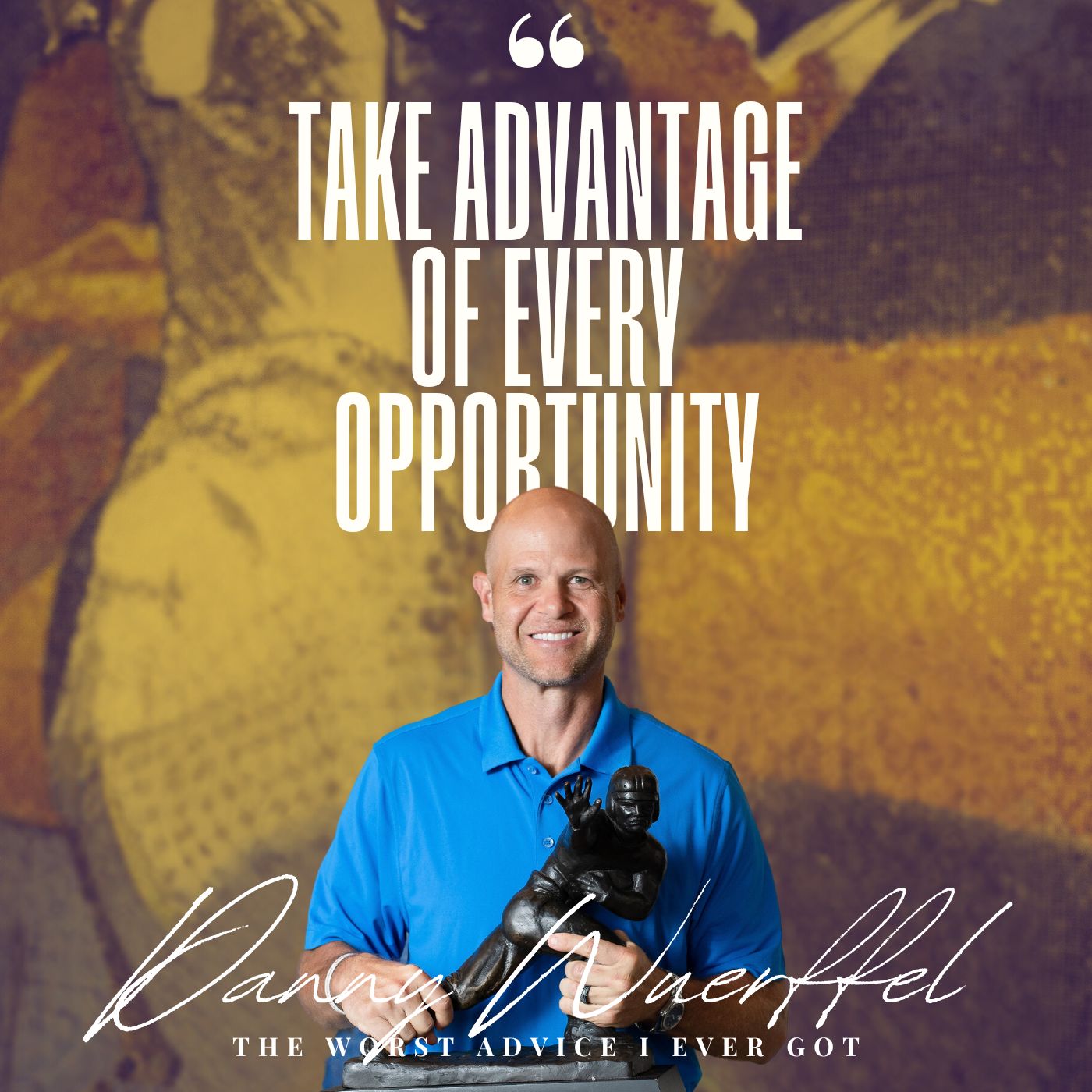
[00:00:37] Speaker B: The worst advice I ever got was to take advantage of every opportunity.
[00:00:44] Speaker A: Okay. Wow, that sounds like really good advice. Actually. Let's, let's unpack that. Tell me what's bad about that advice. Help me understand.
[00:00:52] Speaker B: Well, I think it's like a lot of things, it can be good advice, it can be very helpful advice. I think especially when I was younger, you know, this is sort of a culture ethic I picked up from parents, coaches, teachers, mentors that, you know, try everything, try new things, explore, don't just play one sport. You know, I had some coaches say, make sure you play all the sports because you never know which one you're going to love. And you know, I was a basketball player more at heart and I'm glad I tried football. So I think there's some, some good advice to it. But I also think as you get older in particular and as you begin to figure out life, there's a way that there's sort of a dark side to this advice in which it can really impact you negatively. And I have a feeling we might dive into that a little bit deeper.
[00:01:40] Speaker A: Yeah, that's a, that's a great lead into a natural question of.
So you followed this advice, it sounds like at one point, and it led to maybe so good results that. Can you talk about that a little bit?
[00:01:51] Speaker B: Again, like I said, it's not always bad. It's just there's something called balance. There's something called over extremes on a lot of things. You know, if you can, you can miss the mark right or left, and sometimes the answer isn't on either extreme. And so I think for me, this desire to, you know, as a competitor, to win. So I trained really hard. In fact, one of the things I really worked on was my throwing motion. As a quarterback, I never maximize my power in my throwing efficiency. Think of it like a golfer who maybe had a bit of a slice and could never quite overcome that. So, you know, fortunately I was smart, I was accurate, it worked really well.
But because of that, I decided to really work on my throwing motion. And there's some guidelines to how many like throws you should throw a day that's good for your shoulder. Well, I obliterated that. And I would say for about five or seven years, there's no one on the planet that could have possibly thrown as many footballs as I did.
And now I can't lift my arm and that came back to bite me later in life. So there's just one example of how that hit me.
[00:03:03] Speaker A: Yeah. So the opportunity was presented to you to be successful at something and you just went all in and never stopped and never took a break and it just went on and on and on. And that's what I hear you saying from this.
[00:03:19] Speaker B: Yeah. In that example, you know, I think my son is similar. I have a 17 year old son who, you know, right now his goal in life is to get as big a muscles as he can. So he's in the gym all the time. But he's not recognizing the value of rest for building muscles. Like you have to rest the muscles for them to recover, to grow the most as well as possible fatigue and even worse injury. So our minds, our bodies, our souls, our spirits have to have rest.
I mean, we all know it would happen if you never slept at night, you wouldn't last very long. But like emotionally, mentally, physically, to be able to have these different times, to kind of check out, to kind of rejuvenate is so important. And I think what we do, you know, I work with leaders that live in very stressful environments and under resourced neighborhoods, working with kids and families and they're burning out like crazy because they're always trying to help someone and they're never taking time for themselves. You know, I love the illustration where you get on an airplane and they say, you know, if the oxygen masks come out, you know, they say make sure you help the kids first. No, that's not what they say. They say get your mask on before you help anybody.
Because if you can't breathe, you're not going to be around to help anybody. And so this idea of taking some space and to make it even a bit more personal for me, you know, years ago I was probably in one of the highest stressed times of my life. You know, I was going so fast, working so hard, like being on a treadmill, going too fast for too long and my body shut down. I caught a weird autoimmune disorder called Guillain Barre syndrome. I was paralyzed for a couple weeks for the most Part for a couple more months, I was very limited in my mobility. And then for a year, I was tired, and it was so hard, but it was so good. Like, it forced me to slow down. It forced me to take a little bit of an inventory of how much of my time and energy was just going everywhere. I said yes to everything, took advantage of every opportunity to raise money or speak here or do this or help this person, and it just caught up with me. And the interesting thing happened as I was recovering. So I would wake up each morning and think to myself, what's one thing I can do for my work today that would be impactful? And, like, how can I give some good energy to my family?
And the weird thing was I was really productive because I was very focused and I wasn't caught up with a lot of things that maybe didn't matter as much. But the most important thing, each day I did, it's just like, I think you only have so much kind of Grade A energy, tier one energy. Like, we think we have a lot of it, but we really only have so much.
And where are you putting that? Each day is so important, and often it's. It's for people. You work hard all day, you go home and you're grumpy with your kids. I mean, that's not good, you know, or you spend all your time answering emails, and then when you have an important meeting, you're frustrated and impatient with somebody who needs a little bit extra time. We're not wired to go a thousand miles an hour forever. It'll catch up to you.
[00:06:49] Speaker A: Danny, how does an individual. I mean, it's. It's capitalist society. It's America, right? If an opportunity is in front of you, grab a hold of it. There's a lot of fear of missing out, right? If we don't do that, how do we make those decisions on what to take advantage of and what not to, when to say yes and when to say no. It seems like a very hard exercise. So what's your perspective on that?
[00:07:12] Speaker B: I mean, I think that's part of the challenge of life, is recognizing that just because something is worth doing, it may not be you who needs to do it. It may be somebody else's journey to move into that space.
And, you know, there's a book I read recently called I think Essentialism, and it says, you know, most of the time, we think of, should I do something? Is it a yes or a no?
He said, add an extra category. Add the sort of the heck, yes or he had a Different word for it. And he goes, only do the heck yeses if you can, because those are the things that are uniquely for you. You know, for me, one of the ways I think about this is, you know, what am I passionate about? What is moving my heart or what's breaking my heart? Like, that matters. Like, I pay attention to that.
I've learned over time sort of what I'm good at and what I'm not good at.
And so when those two things mix, if I'm passionate about something and I feel drawn to it or it's breaking my heart, something that feel like I need to get involved in, and it sort of fits with man, I think I can actually step into that.
Then those. Those are get my antenna up that maybe this is a Heck yes. And honestly, it's a tough to really know. So I have found having some great advisors around me, whether it's board members or personal mentors or just good friends that know me and processing these things out loud, I get great feedback. And there's been some things that I was, like, really excited about doing, but after hearing some people close to me, I thought, you know, maybe this isn't the best space for me to invest my time.
[00:08:56] Speaker A: It's very interesting, right? You told a very poignant story about when you were in the NFL and on a daily basis, going to practice. I believe this is when you were in New Orleans and you were having to make the decision of whether to take a left or take a right.
And that is, you know, there was opportunity in those turns.
[00:09:15] Speaker B: Yeah, I would drive down our street, and every morning I had started working at the nonprofit Desire Street Ministries, where I still work. I loved spending time with the kids. I loved investing energy and time to make a difference in a really difficult space.
But every morning I go down to the street, and, you know, if I wanted to go that direction, I'd have to turn left. But to keep pursuing my NFL goals and dreams, I'd turn right to go to practice and train. And probably, like we said earlier, overthrow over train. But I just remember In February of 2004, each day it just got harder and harder for me to keep turning right. And so I decided to retire in that direction. It was a tough, tough decision. But by saying no to the one opportunity to walking away from a professional football career, it opened up the opportunity that then led to so many other things through Desire Street. And I think that's really the key. Like, every time you say yes to something, you may or may not know it. You're Also saying no to something else. So I think you just have to guard, guard those. Yes as well.
[00:10:24] Speaker A: That's really interesting. Every time you say yes to something, you're saying no to something else with, without intention. But it is happening.
How are you evaluating opportunities now, Danny?
[00:10:35] Speaker B: Well, you know, I have some, some guidelines on how one, just how many days a month I'll travel. It helps protect our family. So usually unless a real strange things happen, there's usually no more than six nights a month that I'm gone, which really helps, helps me really protect trips and then you know, family.
The time each day or throughout this different weeks, making sure that that's, you know, solid on the calendar time, that it's just, you know, even if there's nothing scheduled that I'm around and, and having dinners together and so I think that that matters and then keeping a lot of open prayer around what, what other things maybe should get in, into the mix or not. But mostly it's. Does this line up with, with where I'm sensing I've been called the things I've thought through, the way that the mentors have, have guided me. Actually there's even a couple things right now I'm undecided on and I'm running it by some mentors to give me some good feedback and we'll see if those end up on the calendar or they don't.
[00:11:44] Speaker A: Yeah. So just a follow on to that Danny, is you said you have a son that's 17?
I have a 23 year old, a 21 year old. Sounds like her children are very close in age. Probably that point in their lives when they're having to make important decisions and take opportunities or not take opportunities.
So how are you helping them and others evaluate their own opportunities? Advice you give to others?
[00:12:10] Speaker B: Yeah, well, my oldest son's in college and he is trying to meet and visit with as many people as he can and I think that's, that's great. So you know, but he's, he's still gotta, gotta go to class and he's gotta, gotta handle his main business first. So in some ways we're trying to rein him in. He has a high level fomo so he, he does not want to miss anything. So he's one where we're encouraging but trying to reign in. You know, my 17 year old son, he's more introverted, he'd be much more happy to hang around by himself. And so we're actually really trying to push him to do more things. He's on the other side of that, of that spectrum. So I think, you know, the advice, it's hard, you know, it's. It's very personal where you add in the season of your life, there are many kids who.
And many adults who are afraid to do new things and they need to hear the opposite advice that I'm giving. So there are some people that need to have some courage. Their anxiety is limiting what they're doing. The fear of failure. There's all sorts of reasons why people probably should say yes to more opportunities. But for me, I kind of landed on the opposite side of that as well as I know a lot of people do too.
[00:13:22] Speaker C: How do you define the word opportunity?
What is that to you?
[00:13:27] Speaker B: I think one, it's anytime someone asks you to do anything, that's a straight opportunity that's come to you. Maybe someone you know, maybe an email, maybe anything like that. So, you know, that's one I think, you know, if you're thinking about, you know, dreaming, vision, planning, where you could do what you could be, you're going to start thinking. So like for instance, one of the biggest changes for me and my whole experience was, you know, at Desire street, we were doing a lot of things. And when you work in an under resourced neighborhood, there are a lot of needs.
And what happened was that was just too much like we had to figure out what's our niche in this, what can we do well, how do we do that really well and efficient.
And so now Desire street is thriving. We are in the tail end of helping impact 20 neighborhoods over five years, which has been an incredible journey.
We're doing it very efficiently, but we're not doing everything we said. These are many of the things we could do, but we're going to do these few things. We're going to do it well. Chick fil a said we're going to make chicken sandwiches. That's what we're going to do. And we're going to do it really well. And most people, including myself, would say they did.
[00:14:47] Speaker A: Danny, the message I'm taking from this a little bit is that many times opportunities lead to imbalance. All right, I have an opportunity to be a professional athlete, so I'm going to be very, maybe imbalanced on how often I throw the ball or how often I go and work out. I have an opportunity to make a difference in an under resourced neighborhood. So I'm going to dive all in and go all in to do that, to make a difference. It sounds like when we take advantage of every opportunity, we lose balance Yeah,
[00:15:23] Speaker B: I think that's it. I think that's just sort of the flip side to doing too much is there is a cost to pay.
There's a cost to not doing something, and there's a cost to doing something. And I think so often we don't even evaluate what, what is this going to cost me, my family, my health, my mind, my body, if I automatically assume it's a yes as opposed to at least wonder. And, and so I think that's a very, very, very important question to be asking, because if you're not asking it, you're. You're probably.
If your personality is wired a certain way, you may be doing too much.
[00:16:04] Speaker A: Yeah, no, it's a great point.
We try to message something like that at our office. Right. We set goals each year, and you can't have 10 goals, you can't have 12 goals. That's maybe another way to look at it, taking advantage of every opportunity.
You know, opportunities may come today, and that doesn't mean they're gone forever. You might just need to put it on the back burner. That opportunity could be there a year or two from now, but we always feel like it won't be. Right.
[00:16:32] Speaker B: Yeah, I mean, that's very much the case, I think. Had a great conversation yesterday.
The whole sales world and marketing world is designed to make you think, if you don't do this now, it's gone. So then that anxiety is like, I got to do it now. It's like, jump in now or you'll never get this opportunity again. But that's, that's just sort of how that, that game is played. And so I think just recognizing that and thinking maybe, maybe not.
[00:16:56] Speaker C: Yeah, yeah. That's the evolution, I think, of the, of the whole take advantage of every opportunity with this show that we've noticed is it's absolutes. Whenever you say always, never should, that's become a problem, you know, because you have to sit, step back and think about it. So when you tell people, you know, hey, looking for these opportunities, you've got kids and they're growing up and there's going to be a lot of opportunities that, that come their way, how do you avoid saying take advantage of every
[00:17:25] Speaker A: opportunity or you should or you would, where's the line with the absolutes? I guess, Yeah.
[00:17:32] Speaker B: I mean, we have a thing that we do at work called the middle way. When it comes to a lot of things, there are definitely some black and white, right and wrong things in life, but so much more of the life is nuanced. And it's about wisdom. And often sort of, you can, you know, you can be a pushover or you can be a jerk. You know, there's so many things that if you could sort of land in the, in the middle way of processing, I think you can lead to better decisions. And so typically, yeah, those words should, ought, have to the absolute things.
You know, as I get older, there are some absolutes for me, but there just aren't that many as I used to think there were.
And to really be nuanced and, and trying to have wisdom in each situation is so critical. And to me again today, this is in one way, you know, taking advantage of every opportunity is just a little bit imbalanced. And so just asking the question, I think is very important.
[00:18:35] Speaker A: Yeah. Well, Denny, I know that your advice today, the worst advice you ever got, was to take advantage of every opportunity.
I am glad you took advantage of the opportunity to join us today.
[00:18:46] Speaker C: I knew it. I knew.
[00:18:48] Speaker A: I mean, so good. I feel like what you offered today is so sage and so valuable to our listeners. And I just can't thank you enough for sharing personally about how this impacted you and for being our guest today. Danny, it's been a real treat. Thank you so much for joining us today.
[00:19:06] Speaker B: I'm glad to be on it. I think you guys have a real creative idea to get out some great content, so. So thanks for having me. Keep up the great work.
[00:19:14] Speaker A: Wow, jb, that was a real treat for me personally.
[00:19:17] Speaker C: Fantastic. And we got your. Don't beat around the bush line in there.
[00:19:21] Speaker A: Yeah, let's not beat around the bush with that right now and talk about how great Danny was. You know, what I took from Danny's message was the risk of extremes, right? Absolutes. And also, I mean, here's a guy who reach the pinnacle, right, of his position of, you know, his team winning the national championship. And we all think, okay, lather, rinse, repeat what that guy did and we'll reach the pinnacle of what we do. But there's some long lasting impact to that.
[00:19:52] Speaker C: Absolutely. You know, him talking about how he, you know, for five, six, seven years of his career, no one threw a football more than him. That that's what he's saying. He can't lift his shoulder now because that's what taking advantage of every opportunity. And even the way he said it, you know, heard him say, take the advantage of every opportunity. You knew he was really hop, like harping on that word every now, every time you're saying yes to something, you're unconsciously saying no to something else. Like, that's such an interesting thing to think about. It's like, you really do. It's not take advantage of every opportunity. It's take advantage of the right opportunities.
[00:20:25] Speaker A: Tongue in cheek at the end about thanking the good Lord that he decided to take advantage of our request. But he went through a process I'm sure of saying, do I really want to do this or not? And that's that's important to making good decisions.
[00:20:40] Speaker C: A really good thing I hadn't even thought about till just now that, like, he had to evaluate this opportunity. And I'm glad he said yes.
[00:20:47] Speaker A: Yeah, for sure. I'm sure our listeners are glad he said yesterday, too. Hey, thanks, everybody, for joining us this week. Tune in next week for the worst advice I ever got.