Episode Transcript
[00:00:00] Speaker A: Foreign.
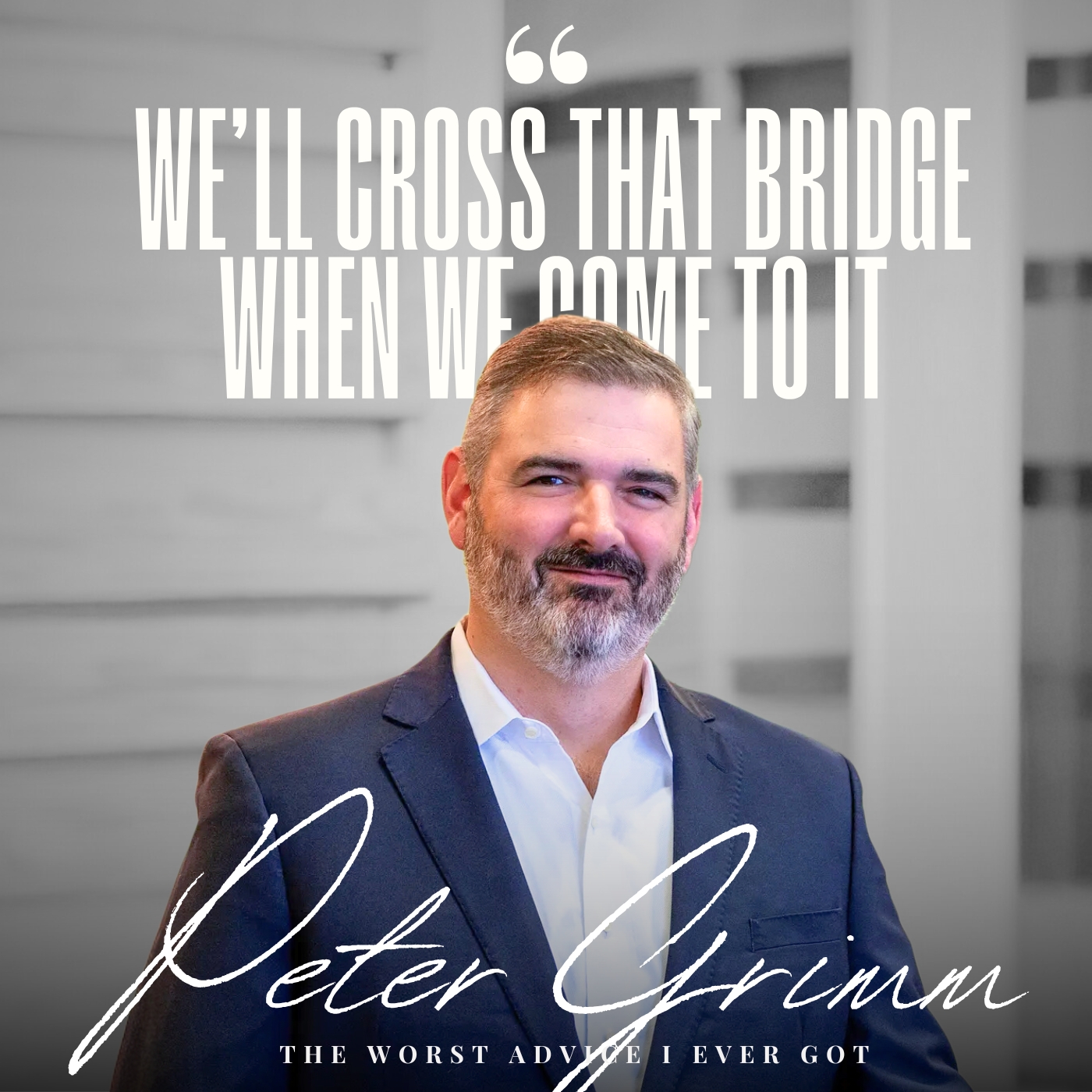
Welcome to another episode of the Worst Advice I Ever Got. I'm your host Sean Taylor along with my producer JB and today our guest is Peter Grimm.
Peter is a managing director at Fahrenheit Advisors where he helps leaders and companies anticipate disruption and future proof their businesses in markets that are changing really faster than ever. Over his illustrious career, Peter has been a strategy consultant, served as CEO of a private equity backed company and worked with organizations ranging from middle market Companies to Fortune 500 firms and governmental agencies.
Today though, we're talking about the danger of waiting too long to act and the advice that sounds responsible until it quietly costs you everything.
Peter, thanks so much for being here today.
[00:00:54] Speaker B: Thanks for having me, Sean. It's a pleasure.
[00:00:57] Speaker A: Well, Peter, for I know you've listened to an episode or two of the podcast, so I know you know our structure is I just jump right in and ask you what's the worst advice you ever got?
[00:01:09] Speaker B: John, the worst advice I ever got was we'll cross that bridge when we come to it.
[00:01:14] Speaker C: Oh yeah, yeah, I've heard that one.
[00:01:16] Speaker A: Yeah, I think we've heard that one too.
Can you explain maybe the genesis of the advice or maybe give some background to this?
[00:01:25] Speaker B: Sure. So you mentioned I was CEO of a private equity backed company.
One of the things that company did was we had a prediction market.
And people these days have probably heard a lot of the headlines about prediction markets have become kind of quite the rage if you follow the markets at all.
And we, we never cross the bridge.
It's kind of the bottom line.
[00:01:50] Speaker C: Just get waiting there.
[00:01:52] Speaker B: The bridge supplies these 11 figure evaluations and we were chugging along at 15 a year and doing just fine. But really wish I hadn't taken that advice at this stage.
[00:02:05] Speaker A: Wow. Wow. So, so talk a little bit more about what the company was and what you were trying to build and just maybe who gave you that advice because you know it, somebody might have gotten that advice in the past and it was perfect for them. Right. You know, so it's just.
Let's get into the circumstances a little bit.
[00:02:24] Speaker B: Yeah. So this Company was a B2B services firm, consulting firm primarily. And we served large enterprises, so big companies that you would know across a whole variety of different industries, including a lot of consumer goods. So you know, a lot of consumer brands that you would have heard of.
And our prediction market was sort of a closed system.
We are, we essentially did consumer research. But our twist was that we used a prediction market of the same algorithms that are behind Polymarket and KALSHI and all that stuff.
But we didn't let people bet really real money.
You know, there were incentives and they, they had, you know, they could win gift cards and things like that, but they weren't betting their own money.
Despite that. It was really accurate, you know, and, and we would ask questions that you would think of from a consumer research product testing and concept and pricing and all the things that consumer products companies would want to test in the market before they launch a new product or figure out how to price it.
And there were a handful of us in that firm that said, you know, there's probably something bigger here and that
[00:03:32] Speaker C: waiting ended up making it so that you never even tried to. It's like, oh, we'll go, we'll, we'll get there when the regulations catch up. And then they don't.
[00:03:39] Speaker B: I mean, the, the, the investors we had in the cap table back then and pretty much everybody involved with the company was kind of just, we'd be happy if we're growing 15, 20% a year and, and doing good work and making decent margins and serving the same clients we'd always serve.
There wasn't really an appetite to go explore any of the. What would have been perceived as, as riskier avenues.
[00:04:04] Speaker A: Yeah, you had a board, I'm assuming, right. So you have a board and the company's doing maybe a little bit better than the marketplace is as successful. So what were you talking about in board meetings if you weren't talking about crossing bold bridges and doing things like. I'm very curious about what the leadership and the board meeting was discussing were it not trying to venture to turn something into, you know, an elite company.
[00:04:30] Speaker B: Yeah, I got to tell you, in that board, I don't think we had a conversation about anything beyond the original thesis.
The group of folks, I think, that thought there might be something more. There were largely within the company, operators within the company, and the board was interested in what next, you know, what was the next big logo we had landed.
[00:04:54] Speaker C: I mean, that's interesting having like a prediction market business that is sort of not future proofing itself, like where it's like, yeah, today, but who knows tomorrow? It's like, literally that is what you do.
[00:05:07] Speaker B: You're doing a prediction market.
[00:05:09] Speaker C: So did you see the kind of irony in that? Then there's this more of a retrospective, like, man, if I only I knew then, would I know now?
[00:05:17] Speaker B: Well, I'll tell you what. So I was relatively young in that role, and so I was around, you know, the board had a lot of very Experienced investors on board and some of the folks that were part of the leadership team were very experienced. Been in this industry a long time. I, I think that there wasn't even an inkling that what some of these prediction markets have accomplished over the last, say five years was even possible.
[00:05:43] Speaker A: When did you first sense there might be a bigger opportunity there and kind of where was it talked about and why do you think it didn't really unearth what didn't happen to unearth the reality of what could have been?
[00:05:58] Speaker B: I think the honest answer to that is that I think we had a sense that that had been tried before and failed and we had a pretty good thing going.
So there wasn't a lot of appetite to go and upset that Apple car and take a shot at something much bigger.
[00:06:15] Speaker C: There's always risk too, in any kind of change, you know, so it's just like it's being very risk averse with thing. Again, kind of the irony of a prediction market that should be able to predict that thing.
[00:06:26] Speaker B: Well, the trick with a prediction market is you got to ask the right questions.
[00:06:29] Speaker C: Andrews.
[00:06:30] Speaker B: That's the real power of it. Right. It's fundamentally, it's about crowdsourcing, using the power of a marketplace to drive a predictive outcome. And that works at scale. It's a law of large numbers and all those sorts of things. But if you're not asking the right questions, you're not going to get the right answers.
[00:06:51] Speaker A: So what were some of the reasons why the focus was, hey, let's just play it safe versus let's maybe embark on something bold or fresh. What, what kept the thinking focused on safety?
[00:07:03] Speaker B: I think the composition of our board and the investors that were in the cap table at that point was probably what drove it. I don't know that anybody in any board meeting explicitly said, no, I don't want to go take more risk.
But you kind of don't have to articulate that when, when we're happy with the results, you know, every quarter.
[00:07:23] Speaker C: Well, I think that's the whole. That's. And that's sort of what we'll cross that bridge means. It's like, I don't know. You don't, it's not like something you even constantly talk about. Like, actually if some, if I ever use that in my kind of day to day life, I say, look, we'll cross that bridge when we come to a meeting. I don't want to talk about this anymore. Yeah, I'll let you know if something comes up that's worth discussing.
[00:07:41] Speaker B: Yeah, that's right.
And it's really ironic too, because I spend a lot of my time working with clients, particularly large incumbents.
Very mature company has been doing kind of the same thing for the same, you know, in the same way for a really long time and been doing just fine.
And there's not a lot of appetite to upset that. Right. The risk, risk reward equation kind of balances out one way where you have these.
A lot of the work I do with these companies to help them anticipate what somebody who doesn't maybe have quite as much to lose might be thinking about that industry in ways where they might be willing to take a, a much higher level of risk and a new approach.
[00:08:27] Speaker A: Peter, it's very interesting to me, though, because it's funny how entrepreneurs are willing to take risks and lose everything.
But big investment houses, who could stand to lose maybe on one investment, but win big on another, maybe just play it safe. Is it fair to assume that was what happened in, in the industry?
[00:08:45] Speaker B: Yeah, I think that's certainly the case for us. And I think it's a broader theme as well. I mean, the more you have to lose, the lower that risk appetite tends to be.
And it's one of the reasons that I've seen so many large companies candidly pay kind of a lot of lip service to. We're going to be innovating, you know, we're going to start an innovation center and we're going to fail fast. And all the things that you hear about trying to be the disruptor and disrupt themselves, and I have yet to see one of those work, I just haven't. Because when it gets to the, you know, the economic cycle turns and, and budgets start getting cut, guess what's the first on the block? Is that innovation center that's failing fast.
[00:09:28] Speaker A: Yeah, that's interesting.
[00:09:30] Speaker B: A lot of risk.
[00:09:31] Speaker C: Would you say this is a unique problem to the company that you were at, or is this sort of something that you see everywhere?
[00:09:37] Speaker B: No, I don't, I don't think it's unique to that company. And I think it actually is kind of proportional to the scale of the company. I think this, this phenomenon, it's been my experience anyway, that the larger a company gets, the less innovative they tend to be and that the lower that risk appetite tends to get.
[00:09:55] Speaker A: When focus shifts from exploration, innovation to preservation, it sort of turns the creative juices on and it basically the risk reward, you know, ratio goes much flatter.
[00:10:10] Speaker B: Right.
[00:10:12] Speaker A: So. So let's talk a little bit. If you, if you don't Mind, because that, that was a great intro to you and the company you're running and where you got this advice. But I think it would actually help, you know, our audience to know what it is you do now.
[00:10:27] Speaker B: So I'm a strategy called consultant first and foremost. So I work with companies to figure out what they want to be when they grow up and how they're going to get there.
So we ask questions like, where are we going to play? How are we going to win?
Importantly, what are we not going to do? And trying to be explicit about that.
A lot of that work tends towards, particularly with larger companies, more mature companies. I mentioned into how do we see disruptive changes coming in time for us to potentially capitalize on as opposed to having to be enforced to react and identifying those things before, you know, you get into a situation. Some of the famous cases, right, Like Blockbuster and Kodak and Toys R Us, and there's a long list of them.
[00:11:16] Speaker C: Any newspaper.
[00:11:18] Speaker B: Any newspaper. And I mean, what we're seeing now is the pace at which this is happening continues to accelerate. It's already orders of magnitude faster than it was, than it was a couple decades ago even. And every year that pace keeps getting faster and faster and faster. So in my view, it's just super important and more important than ever for leaders of leaders who have a lot to lose to be thinking in ways that challenges that conventional wisdom and is thinking about where that next disruptive threat might be coming from.
And a lot of that has to do with scoping the problem, right? Einstein said if he had five minutes to save the world, he'd spend four minutes defining the problem.
I mentioned, you know, making sure you're asking the right questions. That's a lot of what I do with my clients is try to help them make sure they're asking the right questions and importantly, not getting wrapped up in all the noise. There's more noise out there and more data than we've ever had before and it's growing exponentially.
And so it's getting more and more difficult to pick out the signals that are actually meaningful to a business.
[00:12:27] Speaker C: So it reminds me of the Jamie Brindle episode we did where like he talks about the, you know, make a business plan and he's. And basically this is, what he's talking about is like having a five year plan or a ten year plan is like kind of superfluous at this point because everything is changing so rapidly. You need, and you don't want to hold on to this book of like, oh, well, this is the plan, like your last company was doing. It's like, this is the plan. Stick to it.
[00:12:50] Speaker B: It's.
[00:12:50] Speaker C: It's working.
[00:12:51] Speaker B: Yeah, it's fine.
[00:12:52] Speaker C: Don't deviate. And then it's, well, now you've locked yourself in.
[00:12:56] Speaker B: I spent a lot of time talking with companies. In fact, I just did a webinar a couple weeks ago about the difference between strategy and planning. And I'm, I'm really passionate about that because they're, they're both important.
You can't execute well without a plan, but your plan is going to be worthless if you don't have a good strategy in front of. Sure.
[00:13:15] Speaker A: And.
[00:13:15] Speaker B: And that's kind of why I hate the phrase strategic planning, because they're not the same thing.
[00:13:21] Speaker A: Yeah. Well, so the way you were describing a little bit about what you're helping companies with somewhat made me think back to your example where you had a good thing going and you were just looking for ways that it could break, rather than looking for bold new things you could do.
Do you get companies coming to you just solely for the purpose of preservation of the good or helping us think of blind spots we don't have? Or do you have some people coming to you saying, I've got an idea that might just be harebrained. Maybe you can help me turn it into a real business. Is there variability in how you advise your clients?
[00:13:59] Speaker B: Yeah, I consider it kind of offense and defense, both. Yeah. If I think of myself as a coach, I spend, frankly, 75% of my time with clients as a defensive coordinator with larger companies, and maybe 25% of my time with clients playing off offensive coordinator. Right.
Because the principles are the same in terms of how an industry can actually be disrupted. There are some discrete patterns that you see over and over and over again. And once you kind of learn that language, it becomes a playbook for the disruptor or the innovator, the new entrant, or the person trying to play offense.
It also gives you a little bit of a scout team look at what might be coming down the pipe if I'm playing defense as one of those larger companies.
[00:14:48] Speaker A: We love a good sports analogy on the show. Thank you for that, Peter.
So you alluded to the signs or things that you might identify that are happening that could create a disruptor for your company or for your industry.
What are some of the common themes? What are some of the common ingredients to a disruption?
[00:15:11] Speaker B: There are, I talk about generally 10 patterns, and we don't have time today to go through them all. I spent a lot of time with clients kind of educating about what those patterns. Patterns are, how do you recognize them?
But that's kind of the language that I, I think about. And then where I start, when we're playing defense with a larger company who's trying to see what might be out there lurking, is really looking introspectively first and having a really critical discussion with, with yourself or with your leadership team about how it is that you create value for customers.
And that conversation, it still surprises me, but that conversation is a lot more difficult than you would think it ought to be with pretty much every client I've ever worked with.
You know, the marketing department will always tell the world, and we tell ourselves why we're great and we got the best people and got the best this and, or we're the lowest price or whatever it is.
That may or may not be the reason that customers consistently choose you.
And you can't plan what a customer is going to do.
So you got to understand why customers are picking you.
Those are the kind of core assets that we got to play defense around and we got to build modes around, but they're also the, the assets that we can leverage to take advantage of these disruptive ships if we see them coming early.
[00:16:34] Speaker C: Are people sort of like on board with that, of that? Do you find a lot of people, like, know that the world is changing really quickly and it's maybe easier to talk somebody into, like, hey, we need to future proof your business than it was earlier?
[00:16:47] Speaker B: Yeah. I think people are sensitive to the pace of change and how quickly it's accelerating. I think that's true.
I mean, certainly in terms of demand signal for, for what I do in my practice, fuzzy, we've seen an uptick, which is, which is good for us. But I think people are sensitive to the fact the world's changing faster, particularly with AI. I mean, everybody's trying to figure out what does it mean, how do we implement it, how do we balance the risk?
And there's a lot of unknowns about that.
I view it as just another kind of level of technological development. I mean, we had the same conversations when we were talking about the cloud. People were having the same conversations when they started building railroads one hundred and something years ago. It's not different, it's just happening faster.
[00:17:32] Speaker A: Peter, let's circle back to the questions you ask. You know what, what made you center around those questions? And how did you determine that was what you needed to ask? And, and what does it really unveil for you when you ask those questions? To your prospects or to your clients?
[00:17:49] Speaker B: Well, I'll tell you, there's one question that I've asked more companies than any other question. I've probably had this discussion with thousands of companies over these.
You know, what are three things that set you apart? What are your three core differentiators?
And I'm gonna let you guys guess. What do you think the. The most common? I would say 90% of the time
[00:18:09] Speaker A: the first answer is, yeah, their culture. Maybe like culture or values might be what they try to say. Something that's not very measurable would be my guess. Right. Something.
[00:18:21] Speaker B: Very well, I'll tell you that 90 plus percent of the companies I asked that question will say we have the best people. Yeah.
[00:18:28] Speaker A: Yeah. Something.
Yeah.
[00:18:30] Speaker B: And so if that's the answer I get to a question like that, then I. Then I can recognize there's. There's some work we need to do. Not because they don't have the best people they merit. They very well may have the best people, but having the best people today is not a differentiator. Those people can leave. They can go elsewhere. They could go work for competitors.
Now, if you say something like you did, Sean, and I'm proud of you for this, if you say something like, we got the best culture and that helps us attract and retain the best talent in the industry, that's a different answer.
[00:19:03] Speaker A: Yeah, I think I've been a lifelong member of Vistage, and I had a speaker one time, Jenny Smith, talk about competitive advantage. Right. And competitive advantage is only really a competitive advantage if you can uniquely define it and you can measure it. You know, measurable competitive advantage, wouldn't you say?
[00:19:23] Speaker B: Yeah, I totally agree with that. And there's a framework that I probably rely on more than any other over the years. And that's the value discipline framework comes out. The book was written in the 90s. Michael Tracy and Fred Wiersma wrote it.
But I find that super helpful to get to clarity around what is a source of competitive advantage for any company in any industry.
And so that framework talks about every business, and every industry competes kind of on three axes, right? So you're either winning because you got the best product, or you're winning because you can compete at the lowest price, or you're winning because you have the best relationship and knowledge of the customer and can anticipate needs. That sort of thing that I have found so broadly applicable to construction, manufacturing, consumer goods, technology, healthcare. I mean, it just applies across the board. Certainly applies in our industry, Shell.
[00:20:18] Speaker A: Yeah.
[00:20:18] Speaker B: And if you can start thinking along the lines of, I create value because I understand my client's business better and I can make them more successful than any other partner.
That's a pretty clear articulation of what they would call customer intimacy. And then you can build a strategy around that. You can make much better choices about how to defend it from folks who might try to take that away from.
[00:20:41] Speaker C: One of the things I'm seeing right now, especially with AI that you brought up, is that everybody is moving so, so fast that it's making the stock market weird. They're like, are we moving too fast? So is there a. Is there a.
Some benefit to maybe waiting to. Like. And this is where we play the devil's advocate. Like, and from waiting to at least see what the bridge is made out of before we cross it.
[00:21:04] Speaker A: I mean, when we see some of that with, With. With crypto, we've seen a lot of that in areas where people are like, you know, I don't know that I want to be bleeding edge here.
[00:21:14] Speaker C: The horse or the, the cart before the horse there.
[00:21:16] Speaker A: Yeah. What do you think, Peter?
[00:21:18] Speaker B: I. I do, and I don't pretend to be any sort of soothsayer who can see how this is all going to play out. Nobody has any idea, frankly, even. Even the folks who claim to, in my view. But, I mean, Elon Musk called this. I think he said it's like the beginning of the singularity, which is, you know, Elon is Elon. Both.
[00:21:40] Speaker A: Yeah.
[00:21:40] Speaker B: But that seems pretty scary.
Scary concepts.
[00:21:44] Speaker A: Yeah. So, Peter, circling back originally to the worst advice, right. Which we always want to make sure our people that are listening to our show remember what that worst advice was. It was, we'll cross that bridge when we come to it. So what's better advice than that rather than. Than taking that advice? What should people do?
[00:22:04] Speaker B: Well, I think you have to, number one, recognize the biases that are impacting your decision making.
Right. You have to be aware of your own risk tolerances and be able to articulate them as a leadership team, as a board, as a group of investors.
But I think the, the, you know, the wait and see, and we'll cross that bridge when we come to it.
That bridge is going to be here a lot sooner than most people think.
[00:22:31] Speaker A: Yeah. To make an analogy, it used to be, well, let's let other people, you know, take the tip of the spear.
Right. And then once they figured it out, we'll create a business around that and, And. And live a lifetime off of that business. Right.
[00:22:46] Speaker C: Yeah.
[00:22:46] Speaker A: It seems like, you know, Crossing the bridge when you come to it. The bridge used to be a long bridge you could use a whole career over and, you know, raise a family and send kids to college. The bridge kind of feels like, you know, a couple of stepping stones across a little brook now, just the way things change so fast. So, you know, waiting for certainty, which is kind of what I think we used to do, maybe now, is certainly going to provide you a shorter timeline to be able to do something with any type of success. So, yeah, we, we got to make decisions faster, right?
[00:23:17] Speaker B: Yeah, that's right. And I like that you use the word certainty.
Many moons ago, I, I was taught by a very wise strategy consultant, you know, back when I was at Deloitte, gentleman named Fred Pollard. I commend your listeners to go out and check him out. He's, he's really rocket scientist by training, you know, kind of turned strategy consultant.
And he talks about this journey, this problem solving journey. And I, I have a slide that I always use the beginning of every, pretty much every talk. I give that, and I give all the credit to Fred for introducing this to me. But we want to get from uncertainty, from complexity, we want to get to conviction. The goal in any decision making process is conviction. And there's a bunch of different ways you can get there. The one that we're all most comfortable with goes through certainty first.
And that tends to mean we need more data, we need more data, we need more data. And once we have enough data or we feel like we have enough data, we're going to feel certainty and then we can kind of make a decision and drive up towards conviction.
There are other ways to do this that incorporate some more creative ways of thinking where we go. Instead of driving towards certainty first, we want clarity first and we want to understand the options first.
And that type of thinking was. It's honestly, it's how I was taught to think when I worked in the intelligence community.
It's how doctors are taught to diagnose patients. Right? You generate a set of hypotheses using some, some education and experience that you gathered over many years, develop a set of hypothesis, then you go test them and you get to a decision a lot more quickly. You get to conviction more quickly.
[00:25:04] Speaker A: Well, while we all might struggle to make decisions waiting for certainty and, or clarity, I can clearly tell you with certainty that you've been a great guest on the podcast today. And what you're offering in this discussion is going to be extremely valuable to those that listen to this episode because whether it's Somebody being entrepreneurial and starting their own business, or whether it's trying to take a risk just within the business you're in, to maybe be bold and ask for something new, some new responsibility.
Too many times we wait for all the risk to be gone, and we got to have a better way of approaching that in our individual lives and our family lives and our community lives and our business lives. So thanks for sharing your vantage point on all this, your experiences, and, you know, how your worst advice really is very applicable for everybody and the decisions they're making today for the years to come. Thank you, Peter.
[00:25:57] Speaker B: Yeah, it was my pleasure, Sean. Thanks for having me. And thanks, jb.
[00:26:01] Speaker A: Jb, the thing that really stood out to me in our conversation with Peter is the danger of the phrase, we'll cross that bridge when we come to it.
I mean, in the world we're living right now, just think about how dangerous it is. I mean, by the time you get to the bridge, it might not even be there anymore.
[00:26:21] Speaker C: Yeah, right. I mean, that was my big takeaway, too. You know, everything's moving so fast. He said that a bunch of times that, you know, waiting until the problem shows up, it's just not something you can really afford to do anymore. Industries are changing overnight. Technology's changing every hour, it seems. And if you're only reacting when something forces you to react, you're going to be too late.
[00:26:41] Speaker A: Exactly. Exactly. And look, Peter's a. Peter's an example.
[00:26:47] Speaker B: It.
[00:26:47] Speaker A: It's interesting, right? Because the company he was talking about wasn't struggling.
Things are going well. They were growing. 15, 20 a year. Looks really fine on paper.
[00:26:59] Speaker C: Yeah. I mean, nobody in the room, you know, in that boardroom he's talking about, thought there was a problem that even needed to be solved. You know, that's actually where the real risk shows up. You know, when things are almost too comfortable.
[00:27:11] Speaker A: Yeah, without a doubt. And what. What was relearned here today is that that's the moment when leaders have to think about the future the most. Right. You can always be trying to solve something new, anticipating new problems, solving new problems, or experimenting with new ideas.
[00:27:28] Speaker C: Yeah. I mean, that's really the lesson that we took away. Right. If you wait too long, you're going to be left behind.
[00:27:33] Speaker A: Future proofing, your company, your career, or whatever you're building has more relevance today than ever. And in this case, that means questioning advice that sounds like a good plan but is actually holding you back. So, Peter, thanks for sharing your story and your perspective and for all of you listening in today. Thank you so much for joining us. We'll see you next time for another episode of the Worst Advice I Ever Got.