Episode Transcript
[00:00:00] Speaker A: Foreign.
And welcome to the Worst Advice I Ever Got.
I'm your host, Sean Taylor, along with my producer, jb and today our guest is Johnny Snead. Johnny's an actor, perhaps best known for his roles in Fever Pitch, Parks and Recreation, Criminal Minds, and Painkiller, just to name a few. Johnny's a graduate of the University of Texas at Austin. He holds a degree from the University of Mississippi School of Law and worked as a lawyer before developing a career in acting, kind of. But we'll let him get into that.
Johnny, thanks so much for being here today.
[00:00:37] Speaker B: Yeah, you bet, Sean. Thanks for having me.
[00:00:40] Speaker A: So tell us, Johnny, what's the worst advice you ever got?
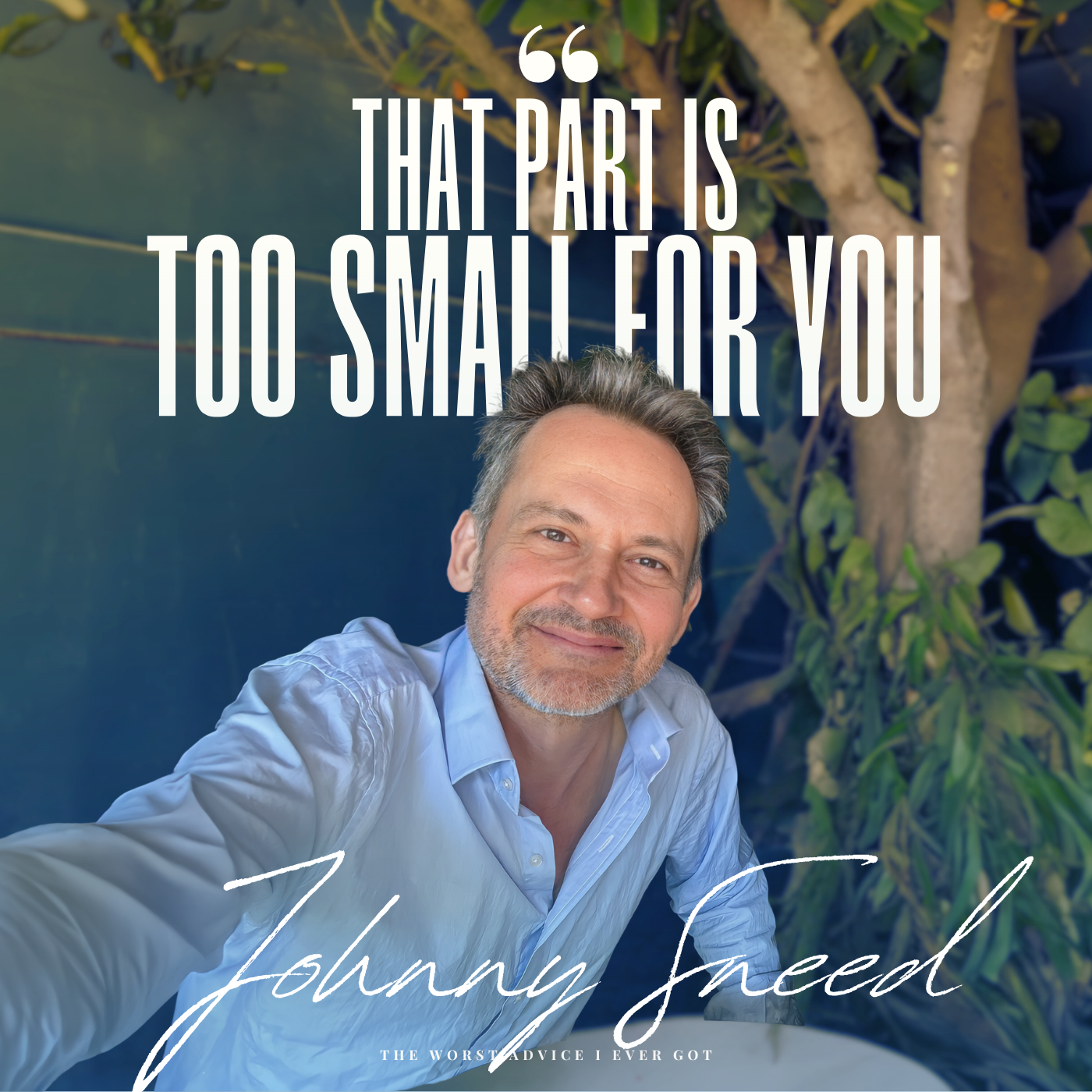
[00:00:44] Speaker B: Well, the worst advice I ever got was don't do that part. It's too small for you.
And that was an acting part in a movie.
And my then manager, who I'm still friends with today, Karen.
So, yeah, so it's funny.
[00:01:04] Speaker A: Here we are, we're.
[00:01:04] Speaker B: We're. We're on this podcast, the Worst Advice I Ever Got.
And I, I've chosen this advice from my then manager about this part that I didn't take.
It's not that this advice, when, when it's the worst advice, it sounds like so catastrophic. Like, you know, this, my. My life is. Has been ruined or. It's not that at all. It's just something.
It has more to do with me, actually than what the advice was. I mean, she was just saying, I think this part is too small for you. I think we can do bigger parts. And it was the fact that I believe that is what I look back on. And so it's not even that her advice was the worst. It's that my understanding of the advice
[00:01:53] Speaker C: was, okay, so the part is too small for you. How did you get to the place where you agreed with her? What's your background here?
[00:02:01] Speaker B: I had, you know, I went to law school and back in. I grew up in Mississippi and I went to college in, In Austin at UT in Texas, and went to law school, Ole Miss. And then I practiced. I passed the bar and practiced law for about a year, but it just was not for me.
And I then took a job in Texas and Dallas working for a finance company that was dealing with used car loans.
And it seems like I'm just. It's just going downhill. Lawyer, basically used car salesman.
And I thought, okay, I gotta, I gotta do something else. And I was in Dallas and I was watching Auto Rocket. It was the first movie that Wes Anderson did. And they were, they shot it in Dallas and I thought, man, that looks so much more fun than what I'm doing right now.
How do I do that? I had reached out to a lady who was writing about entertainment news in the Dallas Morning News and said, you know, how would I get into acting?
And she, you know, graciously took my call and then said, go here. Here's the place. You can take some classes. I mean, I give her so much credit just for taking the call from some. Somebody she didn't know.
[00:03:19] Speaker C: Right.
[00:03:19] Speaker B: And.
And so I took her advice and went to. That was good advice.
I took that, and that was good.
I met an agent there and in Dallas and was able to do some commercials and TV stuff there. But my first actual job I got, as, you know, auditioning for something was actually, coincidentally, a promotion job for the Dallas Morning News. It was. I had to drive around in this, like, 1956 Thunderbird. Every day I would be at a different location, and then Dallas Morning News would publish my picture next to the Thunderbird. Like, you can win this car. Follow the Dallas Morning News delivery guy, be at these locations, and you can come sign up so that there's people
[00:04:03] Speaker C: that remember that you did that. Like, you're the Dallas Morningstar delivery guy, right? You're like, that's where he's going.
[00:04:08] Speaker B: Yes, right. That's me. I mean, I don't know if too many people remember it outside of my family, but. And the lady that won, that ended up winning a car, you'll never forget
[00:04:18] Speaker A: that as long as she lives.
It's interesting, you know, when you were first trying to get into acting, you probably wouldn't gotten that same advice that you got from, you know, the individual that gave it to you. Right.
[00:04:33] Speaker B: I was just auditioning for whatever I could, you know, commercials. I did a lot of little training videos and things like that.
[00:04:40] Speaker A: So that's cutting your teeth, right? That's getting you sort of the chops you need to. To take the next step. So I. I look at this almost like a staircase you had to climb. Little jobs are really kind of big jobs in your mind, right?
[00:04:51] Speaker B: Oh, huge. I mean, that's what's so funny. Yeah, you think? I mean, I was so excited. I got. I got the part. The training video part. I'm so excited. Of course, it's like. I mean, that's the thing that's sort of odd, too, about this gig. I mean, it's one. You finish one, and then you have. Then it's over and you have to go get another one. It's like you're not like just staying at one place and, and, and progressing.
[00:05:16] Speaker A: Yeah. You're always applying for a new job. I have, I've worked at one place, Johnny, for 30 years.
I've never been on a job interview since college. And you literally are on a job interview after every gig, right?
[00:05:27] Speaker B: That's all I do. Yeah. And I always say it's passive rejection because you just basically just don't hear you, don't you? It's not like they tell you no all the time. You just don't hear. You figure, well, I guess they were.
[00:05:38] Speaker C: It shows up on Netflix with somebody else in it. You're like, oh, I guess I didn't get that one.
[00:05:41] Speaker B: I guess I didn't get that one. Yeah, it's like. Or I knew they were gonna, they were starting to shoot today at 10. It's already 10, I guess. Yes. I'm not going.
[00:05:50] Speaker C: So how do you go from, you know, you're excited about getting the training video at At George headquarters to turning down roles in movies?
[00:05:59] Speaker B: I know. I, I was able to get a commercial agent. I did a showcase out here in Los Angeles through people I did know from Dallas that had come out here. It's like a show with a bunch of different actors doing little short scenes. And then from that I met a commercial agent. Then through another showcase, I ended up meeting my manager, Karen. She agrees to take me on. She had been working for a manager as his assistant, but she was going out on her own and then was taking on some clients. But they, they worked with people like, you know, Jim Carrey and Will Ferrell and, and all these, a lot of comedians, a lot of comedy acts. And, and, but, and so then there's me. I mean, you know, she's just taking me on because she liked my showcase. And so I was able to get some work. I got some work on some TV shows, look, called Guest Star and I got a part in a kid's movie, Sleepover is what it was called that produce. One of the producers who I'd become friends with, just talking to him on set, you know, was going on to do another movie.
And I believe the name was Pendulum and it had Ryan Gosling and Anthony Hopkins. And he called Karan and asked if, you know, we have just a small one day part, you'd just be at a dinner scene with Ryan Gosling and Anthony Hopkins and would you want to do it? And Karen, I think in the best spirit, thought, this is not. It's just like one or two lines. You know, you've done some Parts. You've been in a couple now, you've done two movies, and you've had some nice scenes.
I think we should pass.
This part is too small. That her advice sounded right to me at the time. You know, think bigger things. Seems kind of crazy, but okay, yeah, okay, let's pass. And so I passed, and I have regretted it ever since.
[00:08:03] Speaker A: Was. Was it Fracture? Was that the movie? Was it. Was it Fracture?
[00:08:07] Speaker B: Maybe fracture. I'm sorry.
[00:08:09] Speaker A: I've seen that movie, actually, the one you're talking about.
But you're getting advice from someone that's trying to coach you on how to. How to. How to maybe promote your brand, improve your brand as an individual, and they're in contact with one another is what she was basically saying. Right, right.
[00:08:25] Speaker B: And, I mean, I understood it and I wanted to believe it at the time. And maybe if it were. Maybe if I were some bigger name at the time, perhaps doing one or two lines on a movie is maybe not necessary. But I. I think that no matter what, if that opportunity came to me now, I would say yes in a heartbeat. I would do it.
Yeah. I have to just say please, and that's my only word I say in the life. Sure, I'll do it. I'll do it.
[00:08:57] Speaker C: Come on.
[00:08:57] Speaker B: One day of work with Anthony Hopkins and Ryan Gosling. I mean, it's just moronic. When I think back on it, it's like I could have just.
I mean, I could have just asked a question to Anthony or, you know, or Sir Anthony. Excuse me. You know, or Ryan, you know, you
[00:09:15] Speaker C: could have a celebrity movie.
[00:09:16] Speaker B: I could have been, you know, I
[00:09:17] Speaker C: could have been a Ken.
[00:09:18] Speaker B: I could have been a kid. When I Now, reflecting back on it, I think no one is tracking my career like I am. Like, my parents are.
[00:09:28] Speaker A: No worry. I like that.
[00:09:30] Speaker B: No one cares.
No one cares if. Oh, they're not. I don't think anyone is going to not hire me because they think, oh, well, look what he did. He, you know, he took that one day of work on with Anthony Hopkins, so he must really be desperate. I mean, you know, we don't need him in our movie. No one cares. No cares that.
[00:09:50] Speaker A: Can I. Can I dig in that a little bit? Because I think that's very interesting, Johnny. I think it. I take that and I say we're so wrapped up in the minutiae of what we're doing to get ahead, if you will.
[00:10:03] Speaker B: Right.
[00:10:03] Speaker A: And it's pro. The things we're making a big deal probably aren't that big of a deal.
[00:10:07] Speaker B: Exactly.
And look, I mean, would that one day of that on that movie have altered my life? I, I, I doubt it. I mean, it could have.
Anthony Hopkins could be like, this man. This is, he's the next.
[00:10:23] Speaker A: It'd be like, yeah, it'd be like the Coen brothers always wanted to work with John Goodman or whatever, you know, always.
[00:10:29] Speaker B: But realistically, probably would not have changed anything. It's just that it would have been a nice experience, you know, and that's it. And I, that's what I regret is just missing the, the, the day, missing the, the camaraderie and the experience of what I could have learned and what I could have heard, a story I could have heard or anything like that. That's what I regret, I think.
[00:10:52] Speaker C: Did you, so did you learn from it? Did you, have you done it since?
[00:10:56] Speaker B: Well, I would say that I have learned from, in that, that I have a much more easygoing attitude about things, and if, if it seems like helping a director out or in a commercial or whatever it is, I, I'm more willing do things that I just don't think that matters. However, I did take some recent advice from my, from my agents about a part of On Jury Duty. So I would like to say I learned, but I sort of have made that mistake again with Jury Duty.
[00:11:28] Speaker A: You've been in well over a hundred different TV shows, movies, right?
[00:11:33] Speaker B: I mean, commercials and.
[00:11:34] Speaker A: Yeah, I mean, so, so it's interesting that you picked the worst advice you ever got as this one instance. Right?
Because, I mean, you, and you've been on things like Parks and Rec, Friends, you know, Painkillers, the, the recent miniseries that I think Peter Berg.
[00:11:53] Speaker B: Yeah, he, he directed.
[00:11:54] Speaker A: Yeah, yeah, you played, it played a very important part in that. And so you've met some really influential leaders in, in both acting and, and production and, and directing, but this one sticks out in your mind. I'm curious.
[00:12:07] Speaker B: Well, I don't know why that this one bit of advice sticks to. I think it's just I, I recognize it as a sort of a misplaced.
I don't think it was arrogance, but it was like a little bit of thinking that maybe what I was doing was, was more important than I think it really was or something. I don't know if that makes sense. I, I just look back with regret in that it was, it didn't, it didn't, it doesn't make sense to me.
[00:12:34] Speaker A: Now, looking back, that's exactly where I wanted to go with this, Johnny, is I, I kind of look at it from the Standpoint of. Of all of us trying to avoid making decisions that one day we wish we wouldn't have done. Right, in other words.
[00:12:47] Speaker B: Yeah. Right. Yeah. You know, I mean, because those opportunities don't always.
They don't come around again. I mean, some of those.
[00:12:56] Speaker C: Yeah, I mean, you know, like. Like Fever Pitch. You know what I mean? Like what. Have you said no to that?
[00:13:00] Speaker B: Yes. There's a picture of me with a Boston Red Sox sweater, sweatshirt on Instagram. That is my friend. My. That was in la. My friend Jeff brought that to me. That had belonged to this great actor named Jack Kaler, who was in the movie Fever Pitch. And I was in that movie, and we had some scenes together. And Jack, you may ret know from.
If you're a big Lebowski fan like I am, he did that. That interpretive dance where he. Where the dude and John Goodman. There were like four. Four people in the audience.
And Jack Kaler was a wonderful actor. He, you know, he. He and I talked and he told me of, you know, well, I just took the parks. I wanted to work with Dennis Hopper or whoever it was, you know, I just wanted to spend the day with that, you know, and. And that sort of solidified my. I'm like, yes, see, that's the way to do it. That's Jack's the way to do it, you know?
[00:13:52] Speaker C: Well, do you think that. Yeah, maybe you should have listened to Jack, but do you think that Karin would be surprised that we're here talking about her giving you the worst advice you ever got on the podcast?
[00:14:03] Speaker B: She might be, yes and no. Karen is.
He's still a great friend of mine. And. And it wasn't like that. That. That I'm angry about it or. Or that I think it ruined something or not that at all. I just think back, I'm like, I should have just done that. That was just silly of me not to. Not to do that.
[00:14:21] Speaker A: Well, it's. It's funny. The worst advice that you're referencing that you ever got didn't necessarily derail your career. It's really just a. Just, you know, look back with some regret on life experiences that you missed out on because you said no to something.
[00:14:37] Speaker B: I think that was the mistake is. Yeah, the lens was all about, is this? Am I too big for this? And if. And the answer now, I'll tell you is I was not. And I still am not too big for that. But at the time, I thought, yes, you know, maybe this is too small. I'm moving forward, and I need to only do things that are bigger than what I just did. And that's just a mis. F. That was. That's my fault.
[00:15:00] Speaker C: You're the first person to really take full responsibility. Like, he really. Like, she won't be mad when she hears the podcast now. She'll be like, oh, yeah, he said, what's. He's like, look, it wasn't my fault. You're like, no, I said. I told him it wasn't my fault.
[00:15:13] Speaker B: No, I could. I mean, that's the thing, is I
[00:15:15] Speaker C: didn't have to listen.
[00:15:16] Speaker B: I didn't have to listen. She wasn't. It wasn't like it was a mutual decision. I mean, you know, she just was offering her advice since, you know, I could have said yes. I mean, she's my manager. She works for me, you know, That's a good point.
So, yeah, it's all on me. It's all my. It's my fault.
[00:15:38] Speaker A: This has to be common in your profession, though, and people say no to things based upon the concept of what works for them and their brand and what they're trying to build versus the experience. So you're not alone in this, are you?
[00:15:49] Speaker B: I'm sure. I know. And I think I. I think I've seen some other actors say, oh, I wish I. You know, same thing. Like, I said no to the Godfather or whatever. You know, it's like, whatever it was, you know. Yeah. I'm sure I'm not alone in that. That respect. Yeah.
[00:16:04] Speaker A: When opportunity comes, how do you, Johnny, look at it and say, this is the right decision to make?
Boy, that's.
[00:16:11] Speaker B: Isn't that. Isn't that the crux of it right there? I mean, I think it's your. Your instinct and your gut and your heart.
[00:16:19] Speaker A: And,
[00:16:21] Speaker C: you know, obviously, you're on Parks and Rec, and it's like when Aziz Ansari and John Raphael are just like, oh, we said no to everybody right away to seem really important.
[00:16:30] Speaker B: Right.
[00:16:30] Speaker C: And busy.
[00:16:31] Speaker B: Right.
[00:16:31] Speaker C: And so then it's like, oh, no, and now nobody's calling us.
[00:16:34] Speaker B: Yeah, exactly. Go the other way.
[00:16:38] Speaker A: I think there's no one perfect answer is the point. Right. And we're going to use our experience, our value system, our isms, whatever our isms are, to make a decision on whether to take that job or to volunteer at that place or to invest in our time. And. And sometimes it'll be quote, unquote, good, and sometimes it'll be bad.
[00:16:58] Speaker B: And then you realize that, I mean, you can take advice, you know, it's still your decision. I mean, you Know, you'll get a lot of advice from different people throughout your life. You know, people are always saying, well, you ought to do this. But, you know, you still have to listen to your, your instincts, what's. What you, what you feel is, is right.
[00:17:16] Speaker C: And one thing we think about a lot after doing and, you know, a handful of episodes of this is, Is all advice bad left as given to you?
[00:17:25] Speaker B: Yes.
[00:17:25] Speaker C: Like, is there any good advice because of it is like inherently bad? I don't know, maybe.
[00:17:31] Speaker B: Right. And here I, here we are trying to give advice to listeners about advice.
[00:17:39] Speaker A: I'm just trying to tell them, look, everybody's gotten bad advice and how it affects you is something. Look, you learned a ton from this, right?
[00:17:46] Speaker B: Yeah, oh, definitely.
[00:17:48] Speaker A: And probably, I'm sure young actors and actresses have sought your advice on, well, how did you do this? Or what do you think about that? This impacted it, right?
[00:17:57] Speaker B: Oh, for sure. Yeah, yeah.
[00:17:59] Speaker C: If we can get their names, we could see if maybe they want to come on the podcast, talk about you. Yeah, Johnny actually told me he gave me some terrible advice.
[00:18:07] Speaker B: Terrible. Yeah, yeah, yeah.
[00:18:11] Speaker A: Johnny, when you look ahead to, to your family and advising, I know you have a son, right, And a six year old. How does this experience or other experiences, you know, mold the way that you, you try to try to advise him as he grows up.
[00:18:27] Speaker B: I want to try to listen. I'm going to try to listen to him, what he's saying and not be so quick to say, well, this is what, you know, you ought to do. But I, you know, I want to try to encourage him to get experience and, and try things that, that out, that even if they're challenging to him, you know, if he doesn't feel comfortable to try them out, and we're doing that with, you know, little activities, you know, we can see him not wanting to do something at first, and then he tries it and then he's feels really good after he's tried it and you know, just to be encouraging.
[00:19:02] Speaker A: Well, Johnny, I have to say, for someone that said no to a part with Sir Anthony Hopkins and Ryan Gosling, to say yes to a podcast with Sean Taylor and jb, that's the same thing. I, I feel completely elevated now, jb, like, this is the historic moment of my life. Look, someone said no to Sir Anthony Hopkins and said yes to me.
[00:19:27] Speaker B: How about that, right?
[00:19:28] Speaker A: You see, I, I can't thank you enough, Johnny, for joining us. Just the perspective that our listeners are going to get from hearing the worst advice you ever got and how it impacted you is just a great, great thing for them to hear. And so your generosity in sharing your story today is. It's just terrific. So thank you so much for joining us.
[00:19:50] Speaker B: My pleasure.
I'm amazed that you would even be interested to hear what I have to say about it, but thank you.
[00:20:00] Speaker A: Thanks again, Johnny.
[00:20:01] Speaker B: Thank you. Thanks for having me, jb.
[00:20:04] Speaker A: Johnny's such a nice guy.
[00:20:05] Speaker B: That was.
[00:20:05] Speaker A: That was entertaining to get.
[00:20:06] Speaker C: That was a fun one. Friendly. Yeah.
[00:20:09] Speaker A: Friendly. Fun. Yeah. Talking to somebody who's had a great career, has worked with great actors and actresses, just.
It really wasn't anything more than just regret for a missed opportunity, which I found interesting.
[00:20:21] Speaker C: It wasn't even that one opportunity, too. You know, he. He said no to other things. You know, he. He didn't end up being on jury duty, and he had other regrets in his life. I think it was more why he didn't do. Do. It was the. Was the big issue is that I'm too big for this. I'm too important, and I'm not going to do it because this isn't going to be good for making me a big movie star. And it's like, just do the one day, man.
[00:20:43] Speaker A: Yeah. In the moment, he thought it was critical. He thought it was important, and he sees that he wasn't as important as he thought he was. Just like, none of us are in the moment.
[00:20:52] Speaker B: Right. Sure.
[00:20:53] Speaker C: And they.
To his credit, too, he's one of the first people that really took full responsibility for this advice. He was like, listen, I didn't. This is my employee. Didn't need to listen to her. I just did. You've heard that before. We've heard people say, oh, trust yourself, trust yourself, trust yourself. But I don't know if we've ever heard people do the secondary. And also, it was my fault for listening to this advice to begin with.
[00:21:16] Speaker B: Yeah.
[00:21:16] Speaker A: Such a good guy. He reminded me in our first season a little bit of Chris Cleveland, who said, look, I'm the one that gave the worst advice. Nobody gave me worst advice. And he reminded me a little bit of Danny Wurfle, because, Danny, don't. Don't say yes to every opportunity. And here was one where he wished he had said yes to this opportunity. So it's funny how there can be such a fine line between the worst advice and a great opportunity, for example.
[00:21:38] Speaker B: Sure.
[00:21:39] Speaker C: And it doesn't have to be the worst thing. That's one thing we say to our guests, you know, when we're talking to them about being a potential guest on the show. Oh, I don't have anything that, like, ruined my life or. It doesn't need to be. It can just be a kind of an interesting story or something that really stands out in your mind.
[00:21:52] Speaker B: You know, he.
[00:21:53] Speaker C: He went back and forth in this. He's like, I don't know why. Just when you guys asked to put me on this podcast, the Worst Advice Ever got, this just really stuck out.
[00:22:00] Speaker A: And the person he got this advice from remains a great friend today. So the worst advice doesn't have to come from someone who becomes your mortal enemy. It can literally be your. Your spouse or your good friends.
[00:22:12] Speaker C: Absolutely.
[00:22:13] Speaker A: Well, if you enjoyed listening to our episode here with Johnny, you should also check out a lot of his other work. The you haven't listened to all of our episodes. Look us up where you listen to your podcast and. And go back and listen to some of the episodes you haven't heard yet. Or if you listen to all of them and you're a faithful listener. The good news is we'll drop another episode next Friday of the Worst Advice I Ever Got.